
Mon, Sep 14, 2026
[Archive]
Volume 2, Issue 2 (IJHMD 2025)
IJHMD 2025, 2(2): 23-29 |
Back to browse issues page


Download citation:
BibTeX | RIS | EndNote | Medlars | ProCite | Reference Manager | RefWorks
Send citation to:


BibTeX | RIS | EndNote | Medlars | ProCite | Reference Manager | RefWorks
Send citation to:
Kabir M J, Heidari A, Pourasghari H, Khatirnamani Z, Kazemi S B, Honarvar M R et al . Investigating the reasons for not visiting specialists in electronic referral system: patients' perspectives in the west of Golestan province in 2019. IJHMD 2025; 2 (2) :23-29
URL: http://jhd.goums.ac.ir/article-1-51-en.html
URL: http://jhd.goums.ac.ir/article-1-51-en.html
Mohammad Javad Kabir1 

 , Alireza Heidari *2 , Hamid Pourasghari3 , Zahra Khatirnamani1 , Sakine Beygom Kazemi1 , Mohammad Reza Honarvar1 , Reza Golpira4
, Alireza Heidari *2 , Hamid Pourasghari3 , Zahra Khatirnamani1 , Sakine Beygom Kazemi1 , Mohammad Reza Honarvar1 , Reza Golpira4
1- Health Management and Social Development Research Center, Golestan University of Medical Sciences, Gorgan, Iran
2- Health Management and Social Development Research Center, Golestan University of Medical Sciences, Gorgan, Iran ,alirezaheidari7@gmail.com
3- School of Health Management and Information Sciences, Iran University of Medical Sciences, Tehran, Iran
4- Rajaie Cardiovascular Medical and Research Center, Iran University of Medical Sciences, Tehran, Iran
2- Health Management and Social Development Research Center, Golestan University of Medical Sciences, Gorgan, Iran ,
3- School of Health Management and Information Sciences, Iran University of Medical Sciences, Tehran, Iran
4- Rajaie Cardiovascular Medical and Research Center, Iran University of Medical Sciences, Tehran, Iran
Full-Text [PDF 660 kb]
(89 Downloads)
| Abstract (HTML) (569 Views)
Results
Descriptive Findings
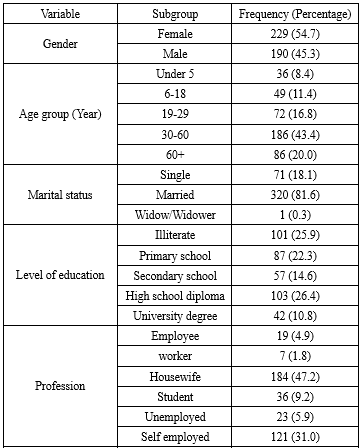
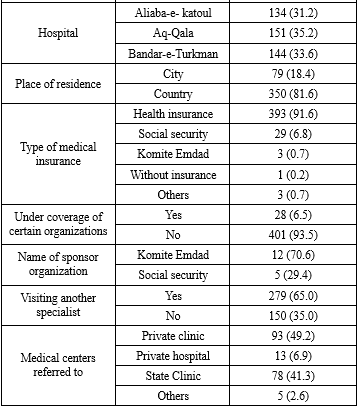
Of the 429 patients, 229 (54.7%) were female. The age distribution showed 186 patients (43.4%) aged 30-60 years. A significant majority, 320 patients (81.6%), were married. In terms of education, 103 patients (26.4%) held a high school diploma. Regarding occupation, 184 patients (47.2%) were housewives, and 151 patients (35.2%) resided in Aq-Qala city. Furthermore, 350 patients (81.6%) lived in villages, while 393 patients (91.6%) had health insurance. Only 28 patients (6.5%) reported being sponsored by support organizations. Among these patients, 65% (279 patients) visited other specialists, while 35% (150 patients) did not see any specialist at all. Notably, 49.2% of those who did not attend the appointed specialist had sought care from various specialists in private clinics. (Tables 1 and 2).
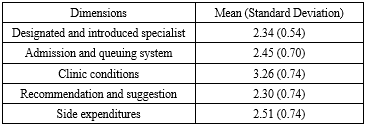
The most influential factors in patients’ decisions were clinic conditions (3.26 ± 0.74), side expenditures (2.51 ± 0.74), and the admission and queuing system (2.45 ± 0.70). Additional reasons for not visiting the specialist, identified through open-ended responses, included recovery before the appointment, forgetting the date, and the specialist’s absence at the scheduled time (Table 3).
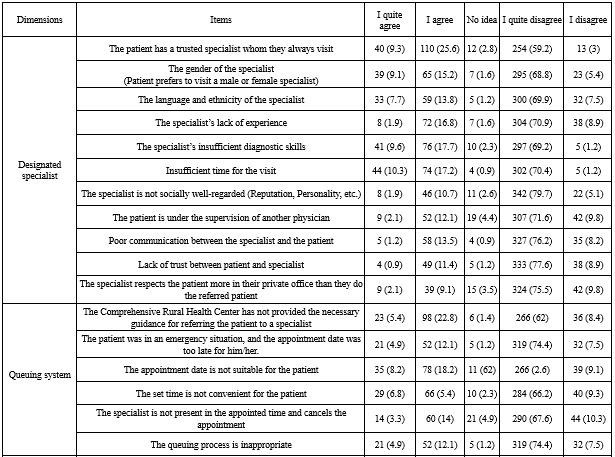
More than one-third of patients (34.9%) reported having a trusted specialist whom they always visit. Over a quarter (28.2%) stated that the referral center had provided insufficient guidance, and 26.4% mentioned that the appointment date was unsuitable. In total, 22.4% cited a long distance from home as a barrier. Additionally, 25.1% indicated that the designated clinic was crowded and disorganized, and 19.9% complained of long waiting times. Another 34.9% could not afford the specialist visits, while 28.9% found commuting expenses high (Table 4).
The multiple regression analysis results are presented in Table 5. Model assumptions-including linearity, normality of residuals, no error correlation, and lack of collinearity-were confirmed.
Significant differences in the introduced specialist dimension were found across age (P-value< 0.001), education (P-value < 0.001), residence (P-value =0.004), and insurance type (P-value =0.042).
For the admission and queuing system, differences were significant for education (P-value =0.014), residence (P-value =0.013), and insurance type (P-value =0.032).
For clinic conditions, age (P-value < 0.001), education (P-value < 0.001), residence (P-value< 0.001), and insurance type (P-value =0.006) showed significant effects.
In others’ advice and suggestions, differences emerged by age (P-value =0.038), education (P-value =0.062), residence (P-value =0.026), and insurance type (P-value =0.028).
For side expenditures, significant differences appeared for residence (P-value =0.004) and insurance type (P -value < 0.001).
Discussion
The present study aimed to determine outpatients’ reasons for not visiting specialists within the eReferral system and to examine their association with demographic characteristics.
Clinic conditions had the greatest effect on patients’ decisions, including long distance from their residence, long waiting times, and crowded clinics. Lux et al. emphasized hospital access as a key criterion in hospital choice (19). Similarly, Taylor et al. found that 32% of patients considered distance an influential factor (24), while another study showed that 17.3% selected specialists based on proximity (25). Williamson et al. and Give et al. also identified long travel distances as major deterrents (18,26), and Koce et al. noted proximity as a motivator for seeking care (27). A U.S. study reported that many patients waited 14 days or more for an appointment (22). In Tehran, Roudpeyma et al. found prolonged waiting times a main cause of dissatisfaction (28).
Side expenditures also scored highly from patients' perspectives, covering consultation, transportation, and related costs, which is consistent with the findings of Behboodi, Kraaijvanger, and Give et al. (15,16,26). The third influential factor was the admission and queuing system; over a quarter of patients reported inadequate guidance by referral centers. Craker’s UK study found that patients were unfamiliar with the health system (29), whereas Durand et al., in a French study, observed well-informed consumers (30). Improving queuing systems through increased staffing, better facilities, and information systems could reduce waiting times. Additionally, attitude and behavioral changes among patients and physicians may also help.
The introduced specialist dimension scored lower, though over one-third of patients stated they always visit a trusted specialist. Kraaijvanger et al. reported that lack of trust in family physicians prompted self-referral (15), and Give et al. identified trust as a key barrier (26). Another study found competence and knowledge crucial in physician choice (25). Meta-analyses show that physician behavior, communication, and time allocation significantly affect satisfaction (31,32).
The others’ advice and suggestions dimension also scored low, though several studies reported patients choose physicians based on others’ recommendations (15,16,25). Koce et al. observed that patients commonly consult relatives about health needs (27), and Beache and Guell noted family encouragement as an influential factor (33).
Open-ended responses revealed that forgetting the appointment date was another reason for not visiting specialists, a finding consistent with previous research (34). A reminder system via mobile or email could mitigate this issue.
There was a relationship between reasons for not visiting and patients’ age, education, and occupation. Older and more educated patients tended to value private consultations and adequate information. Behboodi also reported that work commitments hinder healthcare visits (15).
This cross-sectional study was conducted in only three hospitals. Broader and longer-term studies are needed. Cultural and linguistic diversity among participants (Turkmen in Aq Qala and Bandar Turkman vs. Fars (Persian) in Ali Abad Katul) may have influenced responses; thus, bilingual interviewers were employed. Future qualitative studies could further enrich these findings.
Conclusion
According to the results of the current study, improving the clinic conditions, reducing side expenditures, and reducing waiting times for outpatients may improve the current situation. Providing needy patients with free-of-charge specialized services may help them benefit from these services. Introducing existing services and providing information to the patients, and also facilitating the process of providing services to patients are essential.
Acknowledgement
We thank all the study participants for their assistance with this project.
Funding Sources
This work was supported by Golestan University of Medical Sciences (Grant number 110621). All subjects in this study participated voluntarily and provided informed consent prior to completing the questionnaire. We confirm that the investigation was carried out in accordance with the relevant guidelines and regulations.
Ethical Statement
The study was approved by the Ethics Committee of Golestan University of Medical Sciences (Ethics approval code: IR.GOUMS.REC.1398.049).
Conflicts of Interest
The authors declare no conflicts of interest.
Author Contributions
Conceptualization, supervision, funding acquisition and resources: Mohammad Javad Kabir and Alireza Heidari; Methodology: Hamid Pourasghari and Zahra Khatirnamani; Data collection: Sakine Beygom Kazemi, Mohammad Reza Honarvar and Reza Golpira; Data analysis: Zahra Khatirnamani; Investigation and writing: All authors.
Data Availability Statement
The dataset is available upon request from the corresponding author
Use of Artificial Intelligence
No artificial intelligence tools were used in this study.
Full-Text: (39 Views)
Introduction
The right to health is a fundamental right, and governments must ensure equitable access to healthcare (1). The Alma-Ata Declaration identified primary health care (PHC) as the key to achieving health for all (2), and establishing a referral system is a vital component of PHC (3).
In Iran’s Fourth Development Program (2004-2009), the expansion of rural health insurance focused on Family Physicians (FPs) and the referral system (4). After approval by Iran’s parliament, the Family Physician Plan was linked to the national healthcare network, launching in late 2005 with FPs deployed in rural health centers (5,6).
When patients cannot be treated by FPs at the first level, they are referred to Level 2 for specialized care (3). A referral system helps lower service costs (7), while paper-based referrals often cause delays due to missing information (8). The electronic referral (eReferral) system was designed to improve efficiency and reduce wait times (9), enabling the transmission of patients’ summary records electronically (10).
Although Iran’s healthcare network has achieved considerable success in service provision (11), it has faced challenges in the referral process (12). Despite benefits such as enhanced efficiency, improved access, and reduced wait times (10,11,13), many patients still non-compliant with the eReferral system (14).
Studies show that factors like family income (15,16), service costs, distance to providers (17-19), and service quality (19) strongly influence healthcare provider selection. Moghadasi et al. found that elderly non-referral was affected by individual, structural, environmental, and social challenges related to both medical and non-medical factors (20).
Because few studies exist on eReferral quality and patient non-compliance, it is necessary to identify why patients fail to visit specialists, to inform administrators and planners so they can design interventions for improvement. Therefore, the present study aimed to identify reasons outpatients do not visit specialists within the eReferral system and assess their relationship with demographic characteristics.
Methods
Study design and sample description
This cross-sectional study was conducted in Bandar-e-Turkman, Aq-Qala and Aliabad-e-Katoul, cities located in the west of Golestan province in northern Iran in the second half of 2019. These cities were part of the national eReferral pilot program in Iran and were therefore selected.
According to the guidelines of the eReferral, the referred patients could visit a specialist after receiving an appointment from the FP. Figure 1 shows referral flowchart from first level to second level of health service delivery.
The target population had three classes with an approximate volume of 15,053 people in the first six months of 2019. Thus, approximately 5,103 people in Bandar Turkman County, 5,895 people in Aq Qala County, and 4,055 people in Ali Abad County did not present themselves to the second level of services after being referred. The required sample size was determined using the Morgan table (Cochran formula at a 5% error level and a 95% confidence interval, with a population size of approximately 20,000) and taking into account a 10% attrition rate, 429 patients were selected using stratified random sampling with allocation proportional to the volume of referrals in each city.
In total, 429 patients who were referred by an FP at a rural health center to a specialist physician but they did not visit the designated specialist to receive outpatient services in the district hospital in the past month, participated in the study. The sampling method was stratified random. Each of the three cities was considered as a stratum. The samples were selected according to the volume of each stratum. The number of samples considered for Aq-Qala, Bandar-e-Turkman and Aliabad cities was 151, 144, and 134, respectively.
Data Collection
Data were gathered through a two-part tool: demographic information and a self-designed questionnaire. Items were developed based on studies (16,21,22) and expert input. The questionnaire covered five dimensions and 34 items-designated specialist (11 items), admission/queuing system (6), clinic conditions (10), recommendations of others (2), and side expenditures (5)-rated on a 5-point Likert scale (1 = strongly disagree to 5 = strongly agree). An additional open-ended question asked patients to mention other reasons for non-visiting specialists.
Content validity was assessed qualitatively (expert review of wording and item order) and quantitatively using the Content Validity Ratio (CVR) with 11 experts (23). A CVR ≥ 0.59 was deemed acceptable. Items 1-2, 5, and 7-34 met this threshold; items 3-4 and 6 were retained based on expert mean scores.
Internal consistency was assessed using Cronbach’s alpha, yielding an overall reliability of 0.90 and the following sub-dimension values: designated specialist (α = 0.81), admission/queuing (α = 0.74), clinic conditions (α = 0.80), recommendations (α = 0.70), and side expenditures (α = 0.75).
Questionnaires were completed via telephone interviews conducted by trained and linguistically fluent interviewers. Information was fully collected from all 429 participants (A 99% response rate).
Data Analysis
Descriptive statistics methods (i.e., tables, numbers, frequency and percentages for qualitative data, and means and standard deviations for quantitative data) along with a linear regression model were used for data analysis. All data were analyzed using SPSS version 16. The significance level of all tests was set at 0.05.
Ethical Issues
Participants were assured that their information would remain confidential. Also, the questionnaires were completed anonymously.
The right to health is a fundamental right, and governments must ensure equitable access to healthcare (1). The Alma-Ata Declaration identified primary health care (PHC) as the key to achieving health for all (2), and establishing a referral system is a vital component of PHC (3).
In Iran’s Fourth Development Program (2004-2009), the expansion of rural health insurance focused on Family Physicians (FPs) and the referral system (4). After approval by Iran’s parliament, the Family Physician Plan was linked to the national healthcare network, launching in late 2005 with FPs deployed in rural health centers (5,6).
When patients cannot be treated by FPs at the first level, they are referred to Level 2 for specialized care (3). A referral system helps lower service costs (7), while paper-based referrals often cause delays due to missing information (8). The electronic referral (eReferral) system was designed to improve efficiency and reduce wait times (9), enabling the transmission of patients’ summary records electronically (10).
Although Iran’s healthcare network has achieved considerable success in service provision (11), it has faced challenges in the referral process (12). Despite benefits such as enhanced efficiency, improved access, and reduced wait times (10,11,13), many patients still non-compliant with the eReferral system (14).
Studies show that factors like family income (15,16), service costs, distance to providers (17-19), and service quality (19) strongly influence healthcare provider selection. Moghadasi et al. found that elderly non-referral was affected by individual, structural, environmental, and social challenges related to both medical and non-medical factors (20).
Because few studies exist on eReferral quality and patient non-compliance, it is necessary to identify why patients fail to visit specialists, to inform administrators and planners so they can design interventions for improvement. Therefore, the present study aimed to identify reasons outpatients do not visit specialists within the eReferral system and assess their relationship with demographic characteristics.
Methods
Study design and sample description
This cross-sectional study was conducted in Bandar-e-Turkman, Aq-Qala and Aliabad-e-Katoul, cities located in the west of Golestan province in northern Iran in the second half of 2019. These cities were part of the national eReferral pilot program in Iran and were therefore selected.
According to the guidelines of the eReferral, the referred patients could visit a specialist after receiving an appointment from the FP. Figure 1 shows referral flowchart from first level to second level of health service delivery.
The target population had three classes with an approximate volume of 15,053 people in the first six months of 2019. Thus, approximately 5,103 people in Bandar Turkman County, 5,895 people in Aq Qala County, and 4,055 people in Ali Abad County did not present themselves to the second level of services after being referred. The required sample size was determined using the Morgan table (Cochran formula at a 5% error level and a 95% confidence interval, with a population size of approximately 20,000) and taking into account a 10% attrition rate, 429 patients were selected using stratified random sampling with allocation proportional to the volume of referrals in each city.
In total, 429 patients who were referred by an FP at a rural health center to a specialist physician but they did not visit the designated specialist to receive outpatient services in the district hospital in the past month, participated in the study. The sampling method was stratified random. Each of the three cities was considered as a stratum. The samples were selected according to the volume of each stratum. The number of samples considered for Aq-Qala, Bandar-e-Turkman and Aliabad cities was 151, 144, and 134, respectively.
Data Collection
Data were gathered through a two-part tool: demographic information and a self-designed questionnaire. Items were developed based on studies (16,21,22) and expert input. The questionnaire covered five dimensions and 34 items-designated specialist (11 items), admission/queuing system (6), clinic conditions (10), recommendations of others (2), and side expenditures (5)-rated on a 5-point Likert scale (1 = strongly disagree to 5 = strongly agree). An additional open-ended question asked patients to mention other reasons for non-visiting specialists.
Content validity was assessed qualitatively (expert review of wording and item order) and quantitatively using the Content Validity Ratio (CVR) with 11 experts (23). A CVR ≥ 0.59 was deemed acceptable. Items 1-2, 5, and 7-34 met this threshold; items 3-4 and 6 were retained based on expert mean scores.
Internal consistency was assessed using Cronbach’s alpha, yielding an overall reliability of 0.90 and the following sub-dimension values: designated specialist (α = 0.81), admission/queuing (α = 0.74), clinic conditions (α = 0.80), recommendations (α = 0.70), and side expenditures (α = 0.75).
Questionnaires were completed via telephone interviews conducted by trained and linguistically fluent interviewers. Information was fully collected from all 429 participants (A 99% response rate).
Data Analysis
Descriptive statistics methods (i.e., tables, numbers, frequency and percentages for qualitative data, and means and standard deviations for quantitative data) along with a linear regression model were used for data analysis. All data were analyzed using SPSS version 16. The significance level of all tests was set at 0.05.
Ethical Issues
Participants were assured that their information would remain confidential. Also, the questionnaires were completed anonymously.
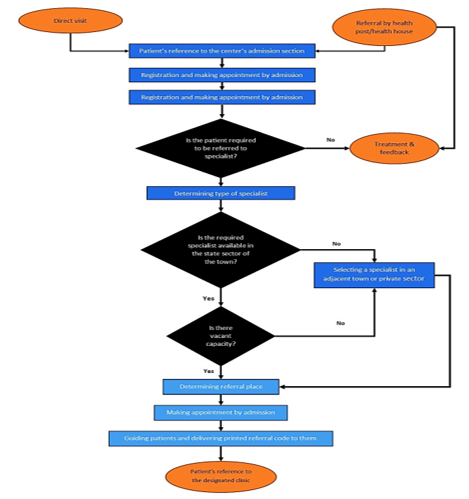 Figure 1. Referral flowchart from level 1 to level 2 |
Results
Descriptive Findings
Of the 429 patients, 229 (54.7%) were female. The age distribution showed 186 patients (43.4%) aged 30-60 years. A significant majority, 320 patients (81.6%), were married. In terms of education, 103 patients (26.4%) held a high school diploma. Regarding occupation, 184 patients (47.2%) were housewives, and 151 patients (35.2%) resided in Aq-Qala city. Furthermore, 350 patients (81.6%) lived in villages, while 393 patients (91.6%) had health insurance. Only 28 patients (6.5%) reported being sponsored by support organizations. Among these patients, 65% (279 patients) visited other specialists, while 35% (150 patients) did not see any specialist at all. Notably, 49.2% of those who did not attend the appointed specialist had sought care from various specialists in private clinics. (Tables 1 and 2).
|
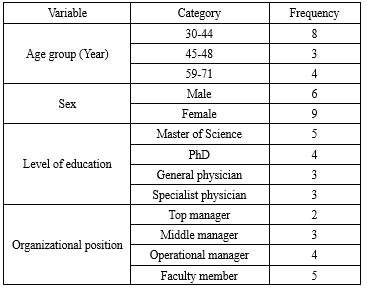
Table 1. Demographic variables of experts and elites that determined the validity of the questionnaire
 |
The most influential factors in patients’ decisions were clinic conditions (3.26 ± 0.74), side expenditures (2.51 ± 0.74), and the admission and queuing system (2.45 ± 0.70). Additional reasons for not visiting the specialist, identified through open-ended responses, included recovery before the appointment, forgetting the date, and the specialist’s absence at the scheduled time (Table 3).
More than one-third of patients (34.9%) reported having a trusted specialist whom they always visit. Over a quarter (28.2%) stated that the referral center had provided insufficient guidance, and 26.4% mentioned that the appointment date was unsuitable. In total, 22.4% cited a long distance from home as a barrier. Additionally, 25.1% indicated that the designated clinic was crowded and disorganized, and 19.9% complained of long waiting times. Another 34.9% could not afford the specialist visits, while 28.9% found commuting expenses high (Table 4).
The multiple regression analysis results are presented in Table 5. Model assumptions-including linearity, normality of residuals, no error correlation, and lack of collinearity-were confirmed.
Significant differences in the introduced specialist dimension were found across age (P-value< 0.001), education (P-value < 0.001), residence (P-value =0.004), and insurance type (P-value =0.042).
For the admission and queuing system, differences were significant for education (P-value =0.014), residence (P-value =0.013), and insurance type (P-value =0.032).
For clinic conditions, age (P-value < 0.001), education (P-value < 0.001), residence (P-value< 0.001), and insurance type (P-value =0.006) showed significant effects.
In others’ advice and suggestions, differences emerged by age (P-value =0.038), education (P-value =0.062), residence (P-value =0.026), and insurance type (P-value =0.028).
For side expenditures, significant differences appeared for residence (P-value =0.004) and insurance type (P -value < 0.001).
|
Table 4. The frequency (Percentage) of reason for not visiting a specialist
 .PNG) |
|
Table 5. The results of the multiple regression model of enter style to predict the reasons for non-referral according to demographic variables
.PNG) .PNG) |
Discussion
The present study aimed to determine outpatients’ reasons for not visiting specialists within the eReferral system and to examine their association with demographic characteristics.
Clinic conditions had the greatest effect on patients’ decisions, including long distance from their residence, long waiting times, and crowded clinics. Lux et al. emphasized hospital access as a key criterion in hospital choice (19). Similarly, Taylor et al. found that 32% of patients considered distance an influential factor (24), while another study showed that 17.3% selected specialists based on proximity (25). Williamson et al. and Give et al. also identified long travel distances as major deterrents (18,26), and Koce et al. noted proximity as a motivator for seeking care (27). A U.S. study reported that many patients waited 14 days or more for an appointment (22). In Tehran, Roudpeyma et al. found prolonged waiting times a main cause of dissatisfaction (28).
Side expenditures also scored highly from patients' perspectives, covering consultation, transportation, and related costs, which is consistent with the findings of Behboodi, Kraaijvanger, and Give et al. (15,16,26). The third influential factor was the admission and queuing system; over a quarter of patients reported inadequate guidance by referral centers. Craker’s UK study found that patients were unfamiliar with the health system (29), whereas Durand et al., in a French study, observed well-informed consumers (30). Improving queuing systems through increased staffing, better facilities, and information systems could reduce waiting times. Additionally, attitude and behavioral changes among patients and physicians may also help.
The introduced specialist dimension scored lower, though over one-third of patients stated they always visit a trusted specialist. Kraaijvanger et al. reported that lack of trust in family physicians prompted self-referral (15), and Give et al. identified trust as a key barrier (26). Another study found competence and knowledge crucial in physician choice (25). Meta-analyses show that physician behavior, communication, and time allocation significantly affect satisfaction (31,32).
The others’ advice and suggestions dimension also scored low, though several studies reported patients choose physicians based on others’ recommendations (15,16,25). Koce et al. observed that patients commonly consult relatives about health needs (27), and Beache and Guell noted family encouragement as an influential factor (33).
Open-ended responses revealed that forgetting the appointment date was another reason for not visiting specialists, a finding consistent with previous research (34). A reminder system via mobile or email could mitigate this issue.
There was a relationship between reasons for not visiting and patients’ age, education, and occupation. Older and more educated patients tended to value private consultations and adequate information. Behboodi also reported that work commitments hinder healthcare visits (15).
This cross-sectional study was conducted in only three hospitals. Broader and longer-term studies are needed. Cultural and linguistic diversity among participants (Turkmen in Aq Qala and Bandar Turkman vs. Fars (Persian) in Ali Abad Katul) may have influenced responses; thus, bilingual interviewers were employed. Future qualitative studies could further enrich these findings.
Conclusion
According to the results of the current study, improving the clinic conditions, reducing side expenditures, and reducing waiting times for outpatients may improve the current situation. Providing needy patients with free-of-charge specialized services may help them benefit from these services. Introducing existing services and providing information to the patients, and also facilitating the process of providing services to patients are essential.
Acknowledgement
We thank all the study participants for their assistance with this project.
Funding Sources
This work was supported by Golestan University of Medical Sciences (Grant number 110621). All subjects in this study participated voluntarily and provided informed consent prior to completing the questionnaire. We confirm that the investigation was carried out in accordance with the relevant guidelines and regulations.
Ethical Statement
The study was approved by the Ethics Committee of Golestan University of Medical Sciences (Ethics approval code: IR.GOUMS.REC.1398.049).
Conflicts of Interest
The authors declare no conflicts of interest.
Author Contributions
Conceptualization, supervision, funding acquisition and resources: Mohammad Javad Kabir and Alireza Heidari; Methodology: Hamid Pourasghari and Zahra Khatirnamani; Data collection: Sakine Beygom Kazemi, Mohammad Reza Honarvar and Reza Golpira; Data analysis: Zahra Khatirnamani; Investigation and writing: All authors.
Data Availability Statement
The dataset is available upon request from the corresponding author
Use of Artificial Intelligence
No artificial intelligence tools were used in this study.
Type of Study: Original Article |
Subject:
Health Policy
Received: 2025/09/28 | Accepted: 2025/11/11 | Published: 2025/12/29
Received: 2025/09/28 | Accepted: 2025/11/11 | Published: 2025/12/29
References
1. Damari B, Heidari A, Rahbari Bonab M, Vosoogh Moghadam A. Designing a toolkit for the assessment of health in all policies at a national scale in Iran. Health Promot Perspect. 2020;10(3):244-9. [View at Publisher] [DOI] [PMID] [Google Scholar]
2. Kabir MJ, Vatankhah S, Delgoshaei B, et al. Determinant criteria for designing health benefit package in selected countries. Life Sci J. 2013;10(3):1392-1403. [View at Publisher] [Google Scholar]
3. Kabir MJ, Heidari A, Honarvar MR, Khatirnamani Z, Rafiei N. Challenges in the implementation of an electronic referral system: a qualitative study in the Iranian context. Int J Health Plann Manage. 2023;38(1):69-84. [View at Publisher] [DOI] [PMID] [Google Scholar]
4. Babazadeh Gashti A, Jafari N, Kabir M J, Heidari A, Behnampour N, Honarvar M R, et al. Assessing rural family physicians performance according to healthcare managers, family physicians, and patients in Golestan Province, Iran. J Mazandaran Univ Med Sci. 2016;25(132):23-32. [View at Publisher] [Google Scholar]
5. Alidoosti M, Tavassoli E, Delaram M, Najimi A, Sharifirad G. The relationship between satisfaction and knowledge about family doctor program in Shahr-e-Kord. Zahedan J Res Med Sci. 2011;13(6):36-9. [View at Publisher] [Google Scholar]
6. Tabrizi JS, Pourasghar F, Gholamzadeh Nikjoo R. Status of Iran's primary health care system in terms of health systems control knobs: a review article. Iran J Public Health 2017; 46(9):1156-66. [View at Publisher] [PMID] [Google Scholar]
7. Stephen WJ. Primary medical care and the future of the medical profession. World Health Forum. 1981;2(3):316. [View at Publisher]
8. Hughes C, Allen P, Bentley M. e-Referrals: why we are still faxing?. Aust J Gen Pract. 2018;47(1-2):50-7. [View at Publisher] [DOI] [PMID] [Google Scholar]
9. Bichel A, Erfle S, Wiebe V, Axelrod D, Conly J. Improving patient access to medical services: preventing the patient from being lost in translation. Healthc Q. 2009;13:61-8. [View at Publisher] [DOI] [PMID] [Google Scholar]
10. Doshmangir L, Bazyar M, Doshmangir P, Mostafavi H, Takian A. Infrastructures required for the expansion of family physician program to urban settings in Iran. Arch Iran Med. 2017;20(9):589-97. [View at Publisher] [PMID] [Google Scholar]
11. Organization WH. The world health report 2000: health systems: improving performance. World Health Organization. 2000. [View at Publisher] [Google Scholar]
12. Bidarpoor F, Rahmani K, Akhavan B, Rahimzadeh A, Pourmoradi A. Identifying Reasons of Non-Attendance of Urban Households in the Comprehensive Centers of Health Services in Sanandaj: A Combination of Two Quantitative and Qualitative Approaches. IRJE. 2019;14(4):302-11. [View at Publisher] [Google Scholar]
13. Straus SG, Chen AH, Yee H Jr, Kushel MB, Bell DS. Implementation of an electronic referral system for outpatient specialty care. AMIA Annu Symp Proc. 2011;2011:1337-46. [View at Publisher] [PMID] [Google Scholar]
14. Eskandari M, Abbaszadeh A, Borhani F. Barriers of referral system to health care provision in rural societies in Iran. J Caring Sci. 2013;2(3):229-36. [View at Publisher] [DOI] [PMID] [Google Scholar]
15. Kraaijvanger N, van Leeuwen H, Rijpsma D, Edwards M. Motives for self-referral to the emergency department: a systematic review of the literature. BMC Health Serv Res. 2016;16(1):685. [View at Publisher] [DOI] [PMID] [Google Scholar]
16. Behboodi F. Effective Factors on Selection of Governmental or Private Hospital with Surgical Patients. Jour Guilan Univ Med Sci. 2000;9(35-36):34-40. [View at Publisher] [Google Scholar]
17. Lux MP, Fasching PA, Schrauder M, Lohberg C, Thiel F, Bani MR, et al. The era of centers: the influence of establishing specialized centers on patients' choice of hospital. Arch Gynecol Obstet. 2011;283(3):559-68. [View at Publisher] [DOI] [PMID] [Google Scholar]
18. Williamson AE, Ellis DA, Wilson P, McQueenie R, McConnachie A. Understanding repeated non-attendance in health services: a pilot analysis of administrative data and full study protocol for a national retrospective cohort. BMJ Open. 2017;7(2):e014120. [View at Publisher] [DOI] [PMID] [Google Scholar]
19. Sahn DE, Younger SD, Genicot G. The demand for health care services in rural Tanzania. Oxford Bulletin of Economics and Statistics. 2003;65(2):241-60. [View at Publisher] [DOI] [Google Scholar]
20. Moghadasi AM, Sum S, Matlabi H. Why do older people not use the public health services of the integrated agingprogram? A multidimensional approach in a qualitative study. BMC Health Serv Res. 2022;22(1):1288. [View at Publisher] [DOI] [PMID] [Google Scholar]
21. Krejcie RV, Morgan DW. Determining sample size for research activities. Educ Psychol Meas. 1970;30(3):607-10. [View at Publisher] [DOI] [Google Scholar]
22. Streubert Speziale HJ, Streubert HJ, Carpenter DR. Qualitative research in nursing: advancing the humanistic imperative. 5th ed. Philadelphia, PA: Lippincott Williams & Wilkins; 2011. [View at Publisher] [Google Scholar]
23. DeVon HA, Block ME, Moyle-Wright P, Ernst DM, Hayden SJ, Lazzara DJ, et al. A psychometric toolbox for testing validity and reliability. J Nurs Scholarsh. 2007;39(2):155-64. [View at Publisher] [DOI] [PMID] [Google Scholar]
24. Calnan M, Rowe R. Trust, accountability and choice. Health, Risk and Society. 2008;10(3):201-6. [View at Publisher] [DOI] [Google Scholar]
25. Mosadeghrad A, Jooya T. Factors influencing patient choice of a medical consultant in Tehran. RJMS. 2017;24(160):62-72. [View at Publisher] [Google Scholar]
26. Give C, Ndima S, Steege R, Ormel H, McCollum R, Theobald S, et al. Strengthening referral systems in community health programs: a qualitative study in two rural districts of Maputo Province, Mozambique. BMC Health Serv Res. 2019;19(1):263. [View at Publisher] [DOI] [PMID] [Google Scholar]
27. Koce F, Randhawa G, Ochieng B. Understanding healthcare self-referral in Nigeria from the service users' perspective: a qualitative study of Niger state. BMC health services research. 2019;19(1):209. [View at Publisher] [DOI] [PMID] [Google Scholar]
28. Roudpeyma Sh, Sadeghian N, Khalighi Monfared M, Azadfar S, Naraghi E, Shakiba Far F, et al. Surveying the outpatient service in Taleghani hospital are patients satisfied? Journal of the Faculty of Medicine. 2003;27(3):209 -15. [View at Publisher] [Google Scholar]
29. Craker SM. Influences on choices to inform a persuasive communications campaign to reduce non-urgent accident and emergency attendance. J Commun Healthc. 2014;7(3):181-96. [View at Publisher] [DOI] [Google Scholar]
30. Durand A-C, Palazzolo S, Tanti-Hardouin N, Gerbeaux P, Sambuc R, Gentile S. Nonurgent patients in emergency departments: rational or irresponsible consumers? Perceptions of professionals and patients. BMC Res Notes. 2012:5:525 [View at Publisher] [DOI] [PMID] [Google Scholar]
31. Wasserman RC, Inui TS, Barriatua RD, Carter WB, Lippincott P. Pediatric Clinicians' Support for Parents Makes a Difference: An Outcome-Based Analysis of Clinician-Parent Interaction. Pediatrics. 1984;74(6):1047-53. [View at Publisher] [DOI] [PMID] [Google Scholar]
32. Narenjiha M, Haghighat S, Baahador H, Shajari J, Haji Molla Hoseini F. The effect of physicians' communication skills on patients' satisfaction. Iranian Journal of Medical Education. 2012;12(1):77-89. [View at Publisher] [DOI] [Google Scholar]
33. Beache SK, Guell C. Non-urgent accident and emergency department use as a socially shared custom: a qualitative study. Emerg Med J. 2016;33(1):47-51. [View at Publisher] [DOI] [PMID] [Google Scholar]
34. Kaplan-Lewis E, Percac-Lima S. No-show to primary care appointments: why patients do not come. J Prim Care Community Health. 2013;4(4):251-5. [View at Publisher] [DOI] [PMID] [Google Scholar]
Send email to the article author
| Rights and permissions | |
 |
This work is licensed under a Creative Commons Attribution-NonCommercial 4.0 International License. |
